From Skirmish to Spectacle:
From the team at Battlefield House Museum & Park
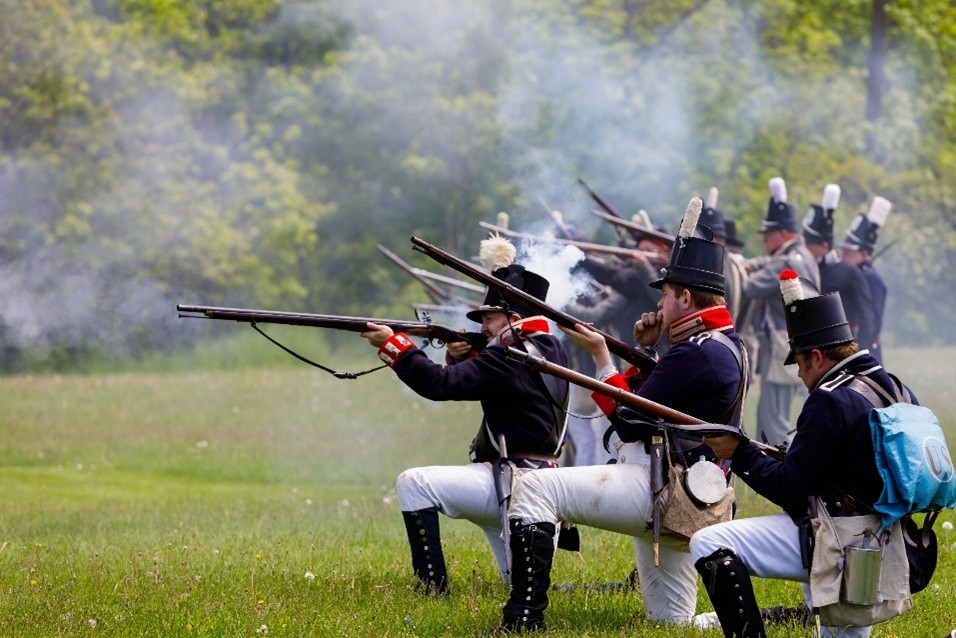
Battle Re-enactment, 2019. City of Hamilton.
Each June, the grounds of Battlefield House Museum & Park National Historic Site transform into an all-encompassing, immersive encounter with the past. The annual re-enactment, one of the longest-running War of 1812 re-enactments in North America, is based on the events of June 6th, 1813, when British forces, alongside Indigenous allies, launched a surprise night attack against American troops during the War of 1812.
This battle, known as the Battle of Stoney Creek, was brief but decisive. Although significantly outnumbered, British-led forces and allies fought against the American advance into Upper Canada through a rare nighttime engagement. This battle was out of desperation rather than careful strategy.
The soldiers knew the mission as “a forlorn hope” and didn’t expect to win or come home; they simply hoped to slow down the Americans and give the rest of the British army a chance to better defend Burlington Heights (today’s Dundurn Castle). But the outcome of the battle helped to halt the invasion at a critical moment, ultimately shaping the war’s direction. This land remained British (and later on, Canadian) soil as a result of the battle. In the years that followed, this landscape and the Gage homestead became a place of memory; tied not only to military history, but to broader themes of identity, territory, conflict and peace in early Canada. Today, this history is commemorated with a weekend-long immersive history event with re-enactments, free for anyone to attend.
From Demonstration to Tradition
In those early years, budgets were small—one of the significant costs from the first year was $75 for gun powder—and attendance varied. It ran off and on in the 1980’s, but by the late 1990’s, the event had grown in scope, and it was a well-established tradition that many local households looked forward to.
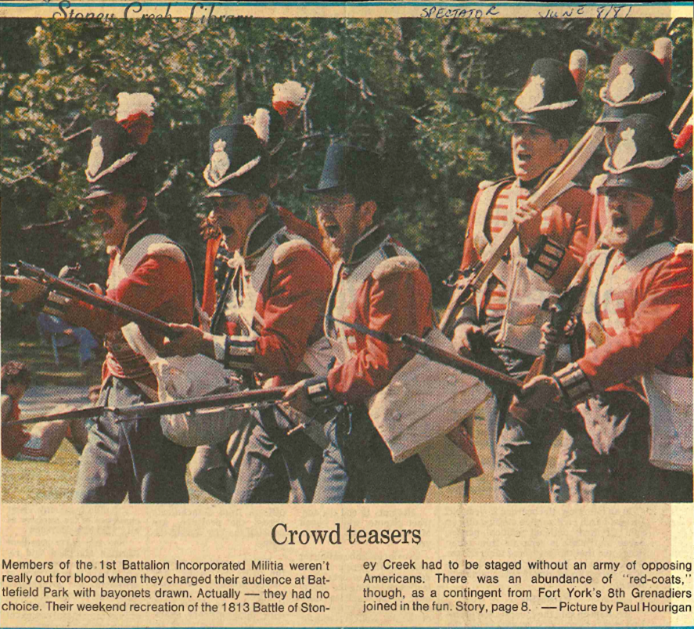
Hamilton Spectator, 1981.
As the event has expanded, so has its purpose. What started as a historical demonstration focused on colonial perspectives of war has now developed into an event that celebrates a wider range of perspectives and voices from this time. It encourages viewers to be aware of the cost and the harms of war. As a result, the event is a more layered form of public history that blends education, commemoration, and community engagement.
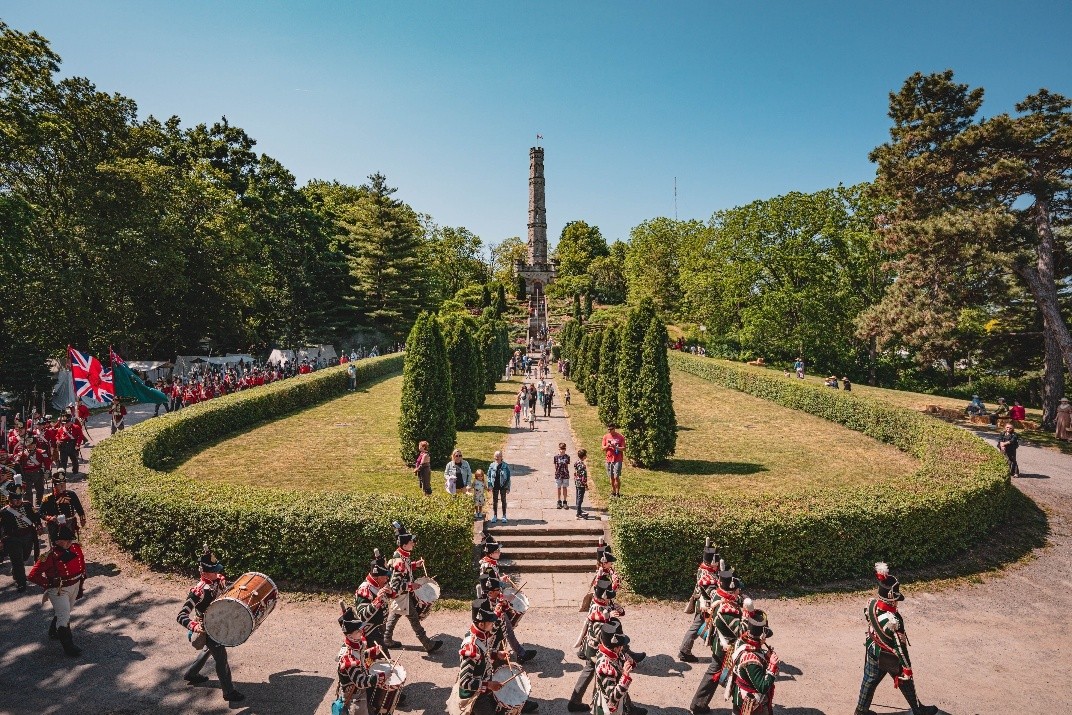
A parade at the Re-enactment. City of Hamilton
The History of the Re-enactment
Like the histories it presents, the re-enactment itself continues to evolve.
In its earlier years, the focus of the event was mainly on military spectacle; the uniforms, battlefield music, formations, and the outcome of the battle. While these elements remain important, there is now more of an emphasis on the contributions of allies, the experiences of various groups involved, and the negative outcomes of war. The event aims to reflect a broader understanding of the past.
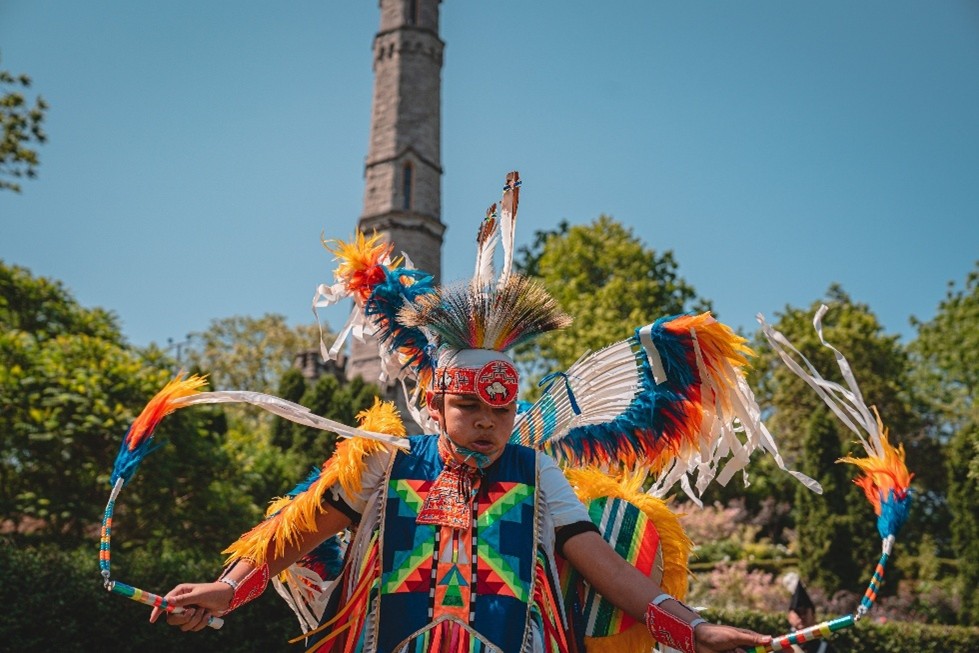
A Dancer from Eagle Flight Singers and Dancers performs at Battlefield Re-enactment. City of Hamilton
Indigenous cultural programming and story-telling have become a more central and meaningful part of the weekend, highlighting stories and perspectives that are essential to understanding the War of 1812, the Battle of Stoney Creek, and the history of the people who lived on this land from time immemorial.
At the same time, the event faces practical challenges shared by many historical re-enactments. Participation relies heavily on hundreds of dedicated volunteer re-enactors and event volunteers, many of whom have been involved for years. As that community changes, organizers continue to find new ways to engage participants and audiences while maintaining the depth and quality of the experience.
These changes reflect the event’s ongoing relevance. The re-enactment, much like history itself, is not a fixed tradition; but an ongoing process of interpreting, revisiting, and sometimes rethinking the past.
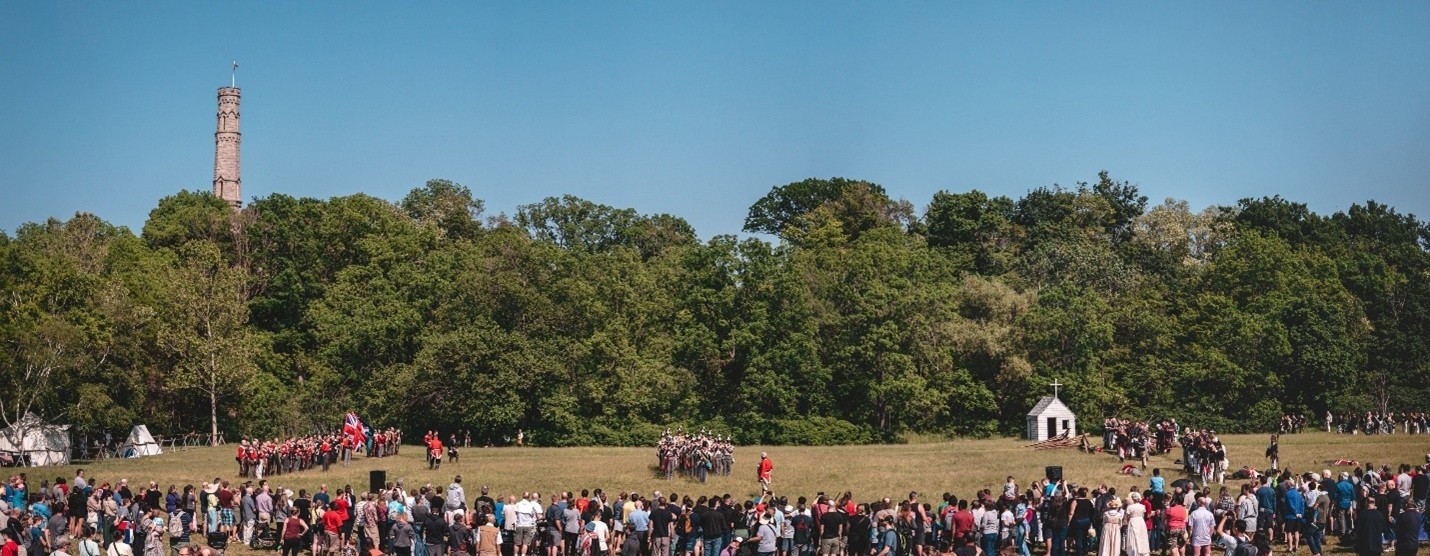
The Re-Enactment of the Battle of Stoney Creek. City of Hamilton.
Experience it for Yourself
Today, the re-enactment remains one of the most immersive ways to experience local history.
Across the weekend, the re-enactment offers a full schedule of programming that goes beyond the battlefield itself.
Visitors can explore active military encampments, browse a merchants’ area, and take part in walk-throughs of the military camps and guided tours of the Stoney Creek Cemetery across the street. Throughout the whole weekend, there are so many things to see and experience, including live performances and demonstrations, historical music ensembles, 18th-century magic shows, military drills, children’s games, , , self-guided Gage House and Monument tours, and interpretive talks on uniforms, weapons, and daily life in the early 19th century. The Haudenosaunee Lacrosse “Great Peace Game” has become a favourite among staff and visitors and enables important conversations around peace and traditions.
The weekend is anchored by three large-scale battle re-enactments, with additional evening features on Saturday including an exciting drone show and fireworks display, creating a lively blend of education, entertainment, and commemoration. But beyond the scheduled activities, the setting leaves the strongest impression. The chance to stand on the battlefield, to see its scale, to hear its sounds, and to move through its landscape, offers a connection to the past that is hard to replicate.
You can read about the War of 1812 in many places. Few offer the chance to experience it where it happened. Come join us and experience it yourself this first weekend in June!
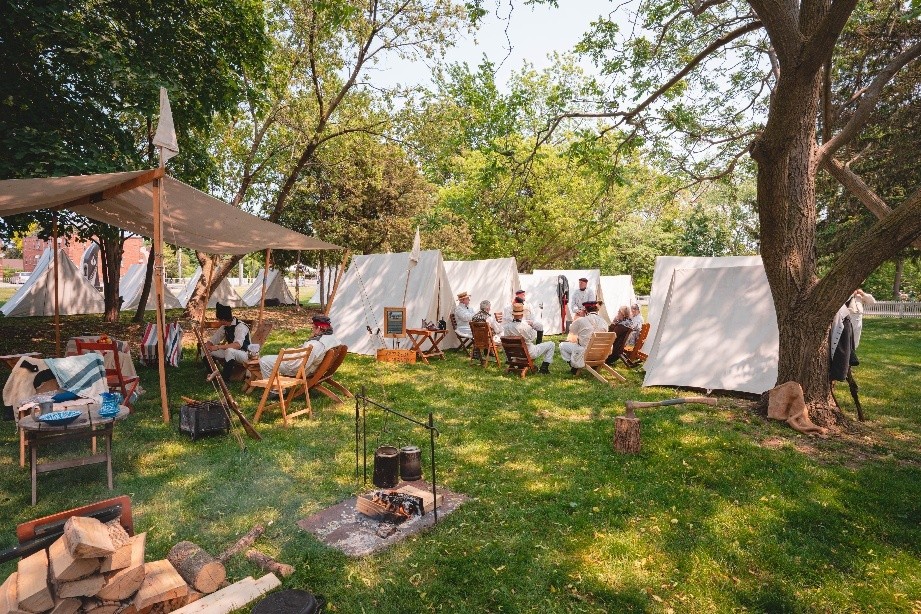
Battlefield Re-enactors' Camp. City of Hamilton.
Sources
Author Unknown. (1981, June 8). Crowd teasers. The Hamilton Spectator.