An Exploration in Heirloom Tomatoes
Hey tomato enthusiasts! Immerse yourself in this historical adventure of tomatoes, a culinary journey that traces its origin across the continents. Despite being slandered as poison, by the late 19th century the tomato finally develops a more accurate reputation—as a tasty, versatile, and nutritious food.
And if you love tomatoes as much as we do, make sure to visit the Dundurn National Historic Site in August and September for our peak tomato season. The Dundurn Historic Kitchen and Historic Kitchen Garden offer seasonal workshops featuring tomatoes, visit our events page to see what's happening this summer.
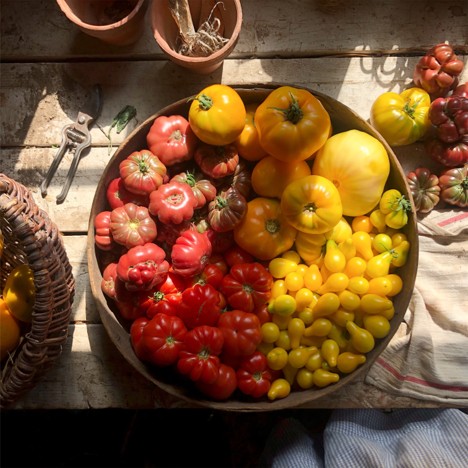
The Dundurn Historic Kitchen Garden grows a large variety of heirloom tomatoes. Clockwise, from top: persimmon tomatoes, great white tomato, yellow pear tomatoes, early large red tomatoes, purple calabash tomatoes. City of Hamilton.
Early Tomatoes
Originating in South America, tomatoes were cultivated by the Inca and Aztec people by 700 A.D. then spread to the Andes Mountains of Peru. While the tomato's wild ancestors grow in Chile, and Ecuador, the fruit was domesticated by precontact Central American farmers. These ancient Mesoamerican civilizations recognized the importance of tomatoes not only as a food source but also for their symbolic and ritual significance. Tomatoes commonly used in religious ceremonies were considered sacred in the cultural and culinary traditions of indigenous people.
Tomato seeds were introduced to Europe though Spanish explorers in the 16th century and like other nightshades was considered poisonous and grown as an ornamental plant, but over time the misconceptions faded, and the tomato began to revolutionize European cuisine. They were named Pomi D’oro or “golden apple” by the Spanish and Pomme D’amour or “love apples” by the French who believed it had aphrodisiac powers like other red fruit such as strawberries. The Spanish also introduced it to the Philippines from where it spread to Southeast Asia and across Asia. It was not until the 18th century that tomatoes began to be more widely consumed in Europe, especially in Mediterranean countries like Italy.
Early references to the tomato in Britain perpetuated the poisonous beliefs despite many knowing that it was eaten elsewhere on the continent. The first known English recipe for tomato is in The Art of Cookery, by Hannah Glasse in 1758, over 200 years after it was introduced in Europe. Glasse, a pioneer of English cookery writing, included tomatoes in just one of her hundreds of recipes entitled "To Dress Haddocks the Spanish Way." This involved cooking the fish with spices, garlic, vinegar and “some love apples, when in season”. A few decades later, the 1797 edition of Encyclopedia Britannica stated: “The tomato is in daily use, being either boiled in soups or broths, or served up boiled as garnishes to flesh and meats.” The faulty foundations became increasingly undermined by the progress of science – the dam was finally breaking.
In the 19th century, the growing use of tomatoes in North America encouraged a market for a range of medicinal products like tomato pills and tomato toothpaste. This and other marketing efforts helped launch the tomato into daily fare. Developing the tomato as a commercial crop focused on the fruit being smooth, uniform in size, and sweet. They were used in pies and patties, side dishes, dried and preserved ,tomato conserves using in maple sugar.
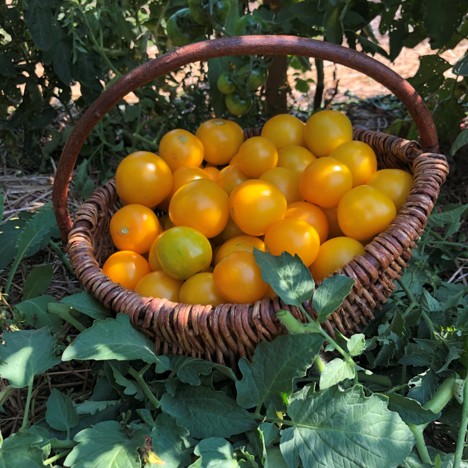
A basket of green gage tomatoes, grown in the Dundurn Kitchen Garden. The name of this variety is inspired by greengage plums. City of Hamilton.
Here’s a few tomato recipes that have been enjoyed in our historic kitchen at Dundurn Castle.
Original Recipe: Tomato Butter
The Home Cook Book, St John, New Brunswick, 1878
Note: Elizabeth Driver, author of Culinary Landmarks states, "The Home Cook Book" is the first example in Canada of a fundraising, charitable, or community cookbook. It was published for the benefit of The Hospital for Sick Children in Toronto, Ontario, and modelled off of "The Home Cook Book" produced earlier in Chicago. Recipes are credited individually to their contributors. This copy is one of four editions published in Saint John N.B. in 1878 -79.
Nine pounds of peeled tomatoes, three pounds of sugar, one pint vinegar, three tablespoons cinnamon, one tablespoon cloves, one and a half tablespoons allspice; boil three or four hours, until quite thick and stir often that it may not burn.
Our Interpretation: Tomato Butter
You may never go back to regular ketchup again. Serve spread on toast for a flavorful breakfast option, alongside a cheese platter as a unique accompaniment, and as a topping for roasted or grilled meats and vegetables and baked potatoes.
Ingredients
9-10 pounds ripe tomatoes
7 cups brown sugar
2 cups cider vinegar
½ tablespoon each of cloves, cinnamon, and allspice
Method
Peel and chop the tomatoes. (peeling and seeding optional) Combine tomatoes, sugar, vinegar, and spices in a pot. Simmer gently, stirring often, until the mixture thickens (3-4 hours). Store in sterilized jars or in the fridge.
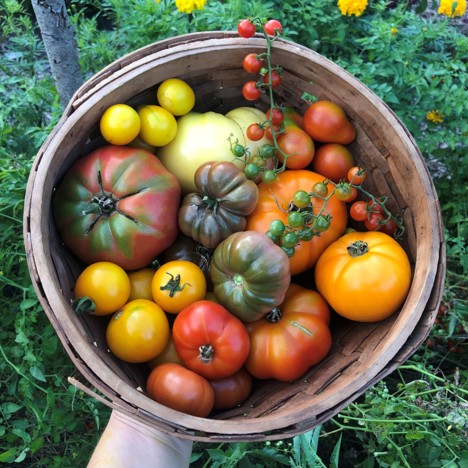
A collection of heirloom tomatoes. City of Hamilton.
Original Recipe: Tomato Pie
The Frugal Housewife’s Manual A.B of Grimsby, 1840
“For pie or preserves the tomato requires a little more sugar than the peach to make it equally palatable. The process of making is much the same as with other fruit.”
Our Interpretation: Tomato Pie
Ingredients:
5-6 medium tomatoes (ripe or green)
1 cup sugar (white or brown)
grated peel & juice of a lemon
cinnamon, ginger, or nutmeg to taste
pastry
Method:
Prepare a crust in a pie plate. We recommend baking this crust for 10-15 minutes and letting it cool before filling to ensure the bottom crust is firm. Deseed the tomatoes by slicing them in half and gently squeezing or tapping out the seeds and jelly (some varieties have little of this). Slice them and lay them into the pie crust. On each layer of tomatoes sprinkle sugar and add the lemon and spice. Once the pie is full you can bake the pie covered with another crust or un-covered for one hour at 350º F. If the pie is covered or is a deep dish the baking may be increased by 30 minutes. Tarts are easily made by chopping the tomatoes blending them with the sugar and seasonings and spooning the mixture into each shell.
Note: This pie can be enhanced by your own creativity. Try adding apples, berries, apricots, or a little cream.
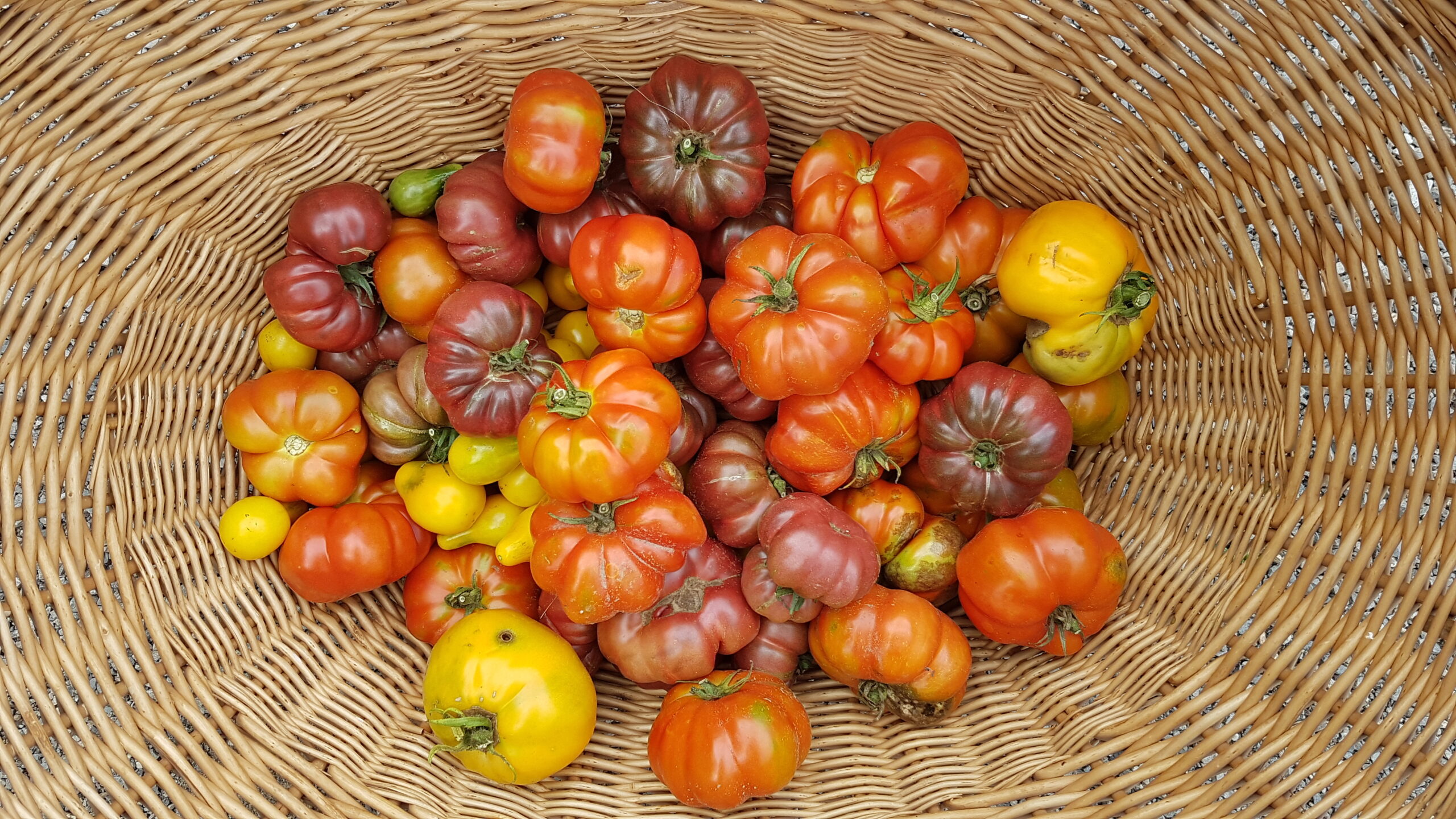
Tomatoes from the Dundurn Historic Kitchen Garden. City of Hamilton.
Original Recipe: Gaspacho
Domestic French Cookery, E. L. Audot, London 1846,Translated from La Cuisiniere de la Compagne et de la Ville, Paris, 1835
Take two onions, some tomatas, a handful of green pimento, a cucumber, a clove of garlic, parsley, and chervil; cut the whole into small pieces, and put them into a salad bowl. Add as much crumbed bread as will form double the quantity which the dish already contains; season with salt, pepper, oil, and vinegar, like a salad, and complete the gaspacho with a pint of water to make the bouillon. Gaspacho is eaten with a spoon; it is a kind of raw soup. It is a favourite dish with the Andalusians and is very refreshing and wholesome in their warm climate.
Our Interpretation: Gaspacho
Notes: Most modern methods use a food processor to purée this delicious fresh soup. Amounts of ingredients are modifiable. A Pimento is a sweet pepper but a hot pepper can add a depth you may like. Start by trying this combination:
Ingredients:
1 onion 4 large tomatoes
1 green pepper 1 cucumber
1-2 garlic cloves 2 slices of stale or toasted bread
½ cup of oil, salt and pepper 1-2 cups of water
Method:
Loosely chop all the ingredients and add them to a blender or food processor including the water and seasonings. Blend the Gazpacho mixture to the smooth or chunky texture you prefer. Adjust seasoning, if needed. Serve immediately, garnished as desired or chill for up to 2 days. Notes: You can blend in ice cubes to chill the soup quickly in place of some of the water. Optional garnishes: herbs, croutons, onions, tomatoes, avocado, chopped eggs, even cooked shrimp!
Sources
“By the Numbers: Canadian Tomatoes.” UFCW Canada, 26 July 2023, ufcw.ca/index.php?Itemid=6&id=33461%3Aby-the-numbers-canadian-tomatoes&lang=en&option=com_content&view=article.
Mirza, Shalra. “Origin of Tomatoes: The Ancient American Plant and Its Culinary Significance.” History Cooperative, 11 Mar. 2024, historycooperative.org/origin-of-tomatoes/.
Pesticide Risk Reduction Program, Pest Management Centre, and Agriculture and Agri-Food Canada (2023). Crop Profile for Greenhouse Tomato in Canada. Government of Canada Publications. https://publications.gc.ca/collections/collection_2024/aac-aafc/A118-10-24-2023-eng.pdf
Van Andel, Tinde, et al. “Sixteenth-century tomatoes in Europe: Who saw them, what they looked like, and where they came from.” PeerJ, vol. 10, 17 Jan. 2022, https://doi.org/10.7717/peerj.12790.
“You Say Tomato, We Say Statistics - Statistics Canada.” SatsCanada, 25 July 2023, www.statcan.gc.ca/o1/en/plus/4182-you-say-tomato-we-say-statistics.