From Staffordshire to Dundas
From the team at Fieldcote Memorial Park and Museum
When you walk into the Beyond the Blue and White exhibit at Fieldcote Museum, you might find yourself doing a double take. Wedgwood, after all, tends to conjure a very specific image: soft pastel blues, delicate white classical figures, and an unmistakable matte finish. It is a style so iconic that many of us feel we know Wedgwood before we ever step into a gallery.
And yet, the pieces in Beyond the Blue and White challenge that stereotype. Visitors to the exhibit encounter ceramics that stretch, bend, and even completely sidestep the familiar blue-and-white, candy-coloured palette. These objects can prompt a surprising question: if Wedgwood doesn’t look like Wedgwood, is it still Wedgwood at all?
This is where things get interesting. To answer that question, we’ll dig into the histories of eighteenth-century England, and early twentieth-century Hamilton and Dundas. The answer lies in the life of one particularly well-trained and enterprising potter: George Emery.
Young Apprentice in the Potteries
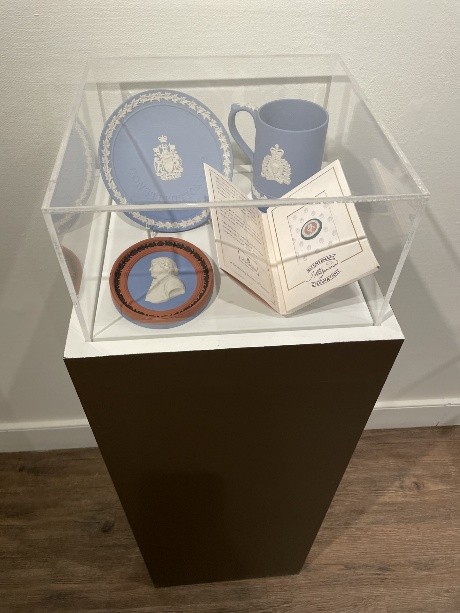
Jasperware Pieces, Beyond the Blue and White Exhibit by King Heritage and Cultural Centre, on display at Fieldcote Memorial Park & Museum, City of Hamilton.
At the age of twelve, when a child today might be busy with homework and video games, Emery began a fourteen-year apprenticeship at Wedgwood. Apprenticeships of this length were not unusual in the late nineteenth century. Mastering ceramics required time, repetition, and the patient learning of technical knowledge through trial and error. Even today, Wedgwood’s apprentices require 10 years to master the craft.
By the time Emery entered the workshop, the Wedgwood firm had already been shaping the ceramic world for over a century. Founded in 1759 by Josiah Wedgwood, the company had built its reputation on both innovation and organization. Wedgwood was not only a talented designer but also a savvy industrialist, pioneering new methods of quality control, division of labour, and marketing.
Perhaps one of the firm’s most famous contribution to ceramic history was jasperware, developed in the 1770s: an unglazed stoneware available in a range of pastel colours, most famously pale blue, decorated with crisp white relief figures inspired by classical art. Producing such pieces required extraordinary precision, and it was this precision that Emery spent his teenage and early adult years learning to achieve.
From Staffordshire to Hamilton
In May 1912, at the age of thirty-one, George Emery moved to Canada, much to the dismay of his employers. Upon submitting his notice of departure, Emery received the following handwritten note from Frank Wedgwood, the great-great grandson of Josiah Wedgwood, that read:
“It is of great regret that we learn that you had decided to go to Canada because we realize that we will be loosing one of our best potters, and one who has always had the interest of the firm at heart. You have been with us from a boy and we hope you will always have pleasant memories of your time here at Etruria. Should you at any time need a reference do not hesitate to use our name which, even in Canada carries, we know a certain weight.”
Emery soon found employment with Campbell & Son Potters on Locke St., and later with the Canadian Porcelain Company Limited. This company specialized in industrial ceramics, specifically electrical insulators and fixtures, products that were essential to the electrification of cities and the growth of modern infrastructure.
For a man trained in the decorative traditions of Wedgwood, this might seem like an unexpected turn. Yet industrial ceramics demanded just as much technical expertise as their decorative counterparts. Clay had to be prepared precisely, kilns monitored carefully, and finished pieces tested for durability and insulation properties. Emery’s apprenticeship had prepared him well for this work, even if the end products were to appear on a utility pole rather than a mantlepiece.
Ecanada: Wedgwood Techniques on Canadian Soil
Ecanada wares clearly reflected the influence of Wedgwood. They incorporated jasperware techniques and classical decorative motifs, echoing the visual language Emery had absorbed during his years in Staffordshire. But these pieces were being made in Hamilton, using materials available in Canada and aimed at a Canadian market. They were referred to as “Canadian Wedgwood” by some of their clients.
This blending of old-world training and new-world context helps explain why some of the ceramics in Beyond the Blue and White feel both familiar and unfamiliar at once. They are part of the Wedgwood tradition, but they are also the product of local adaptation.
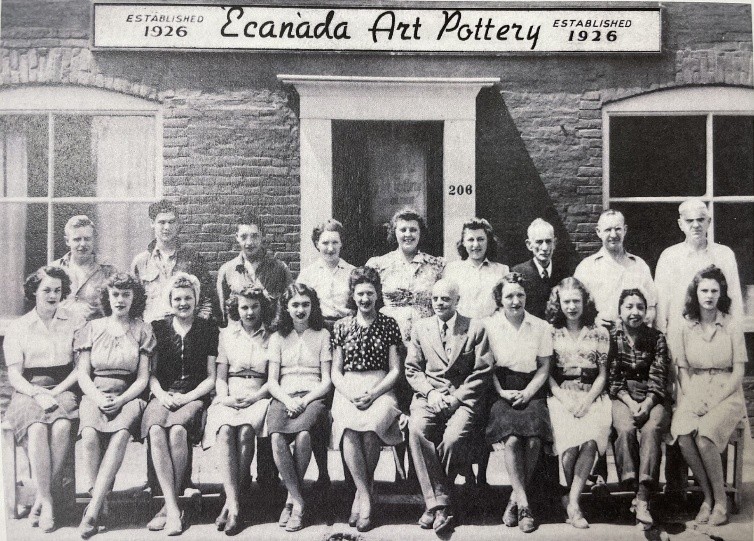
Ecanada Art Pottery Company Photograph, approximately 1940, George Emery Sr. bottom middle row. Photograph courtesy of David Belland.
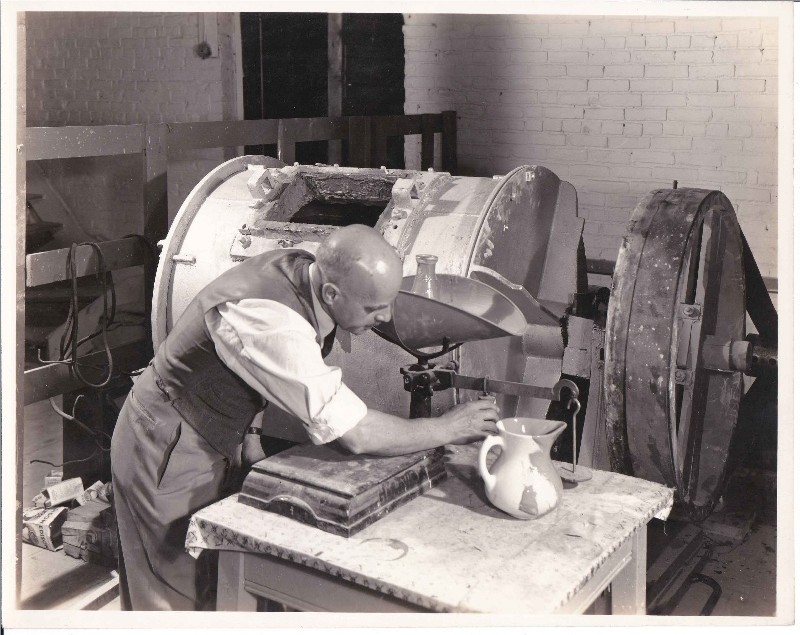
George Emery is shown carefully measuring ingredients for his stoneware in what appears to be a milk bottle. Photograph courtesy of David Belland.
When Wedgwood Stops Looking Like Wedgwood
One of the most intriguing aspects of the Beyond the Blue and White exhibition is the way it unsettles our visual expectations. Many visitors arrive with a mental image of Wedgwood that is dominated by blue jasperware, only to discover that the company’s output was far more diverse.
Wedgwood produced ceramics in a wide range of colours, forms, and decorative styles, particularly as it adapted to different markets over the centuries. When these designs were interpreted by potters trained in Wedgwood techniques, like Emery, or produced specifically for North American consumers, they often moved even further from the iconic blue-and-white palette.
George Emery’s life offers a compelling example of how global industries were built on the movement of skilled individuals. His apprenticeship in Staffordshire connected him to a centuries-old ceramic tradition, while his immigration to Canada allowed that tradition to take root in a new environment.
This kind of knowedge transfer was not unusual in the early twentieth century, but it often goes unnoticed in local histories. We tend to focus on large factories or prominent business owners, overlooking the craftspeople whose hands and expertise made production possible.
Yet it is precisely these individuals who ensured that techniques, styles, and industrial knowledge crossed oceans and shaped communities like Hamilton and Dundas.
Why George Emery Still Matters
More broadly, his story reminds us that the objects we see in museums are rarely the product of a single place or moment. They are shaped by networks of people, ideas, and materials that stretch across continents and generations, and belong to all of those who influenced their creation.
Looking Beyond Blue and White
I encourage you to visit the Beyond the Blue and White exhibit before is closes at the end of May and choose a Wedgwood or Ecanada piece to focus on. Pay attention to its delicate detail, colours and craftsmanship, and the cultural iconography and imagery chosen for the piece. Imagine its object biography; who trained for years to make that piece, how its colours were chosen, where it was “born”, where it is today and even where it might one day end up.
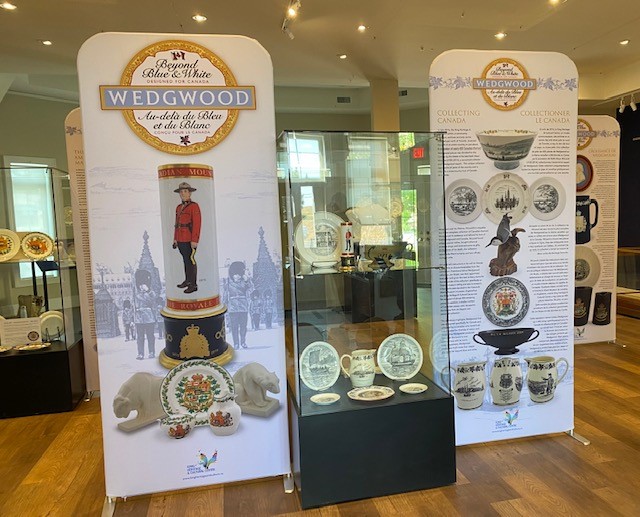
Beyond the Blue and White Exhibit by King Heritage and Cultural Centre, on display at Fieldcote Memorial Park & Museum. City of Hamilton.
Sources
Beland, D. (2020). Ecanada Art Pottery, George Emery, A Man, His Art & His Legacy (J. Auty, Ed.; pp. 0–116) [Review of Ecanada Art Pottery, George Emery, A Man, His Art & His Legacy]. Brant Service Press.
King Heritage & Cultural Centre. (September 2022). Beyond the Blue & White: Wedgwood Designed for Canada [Exhibit]. Fieldcote Memorial Park & Museum, 64 Sulphur Springs Road, Ancaster, Ontario, L9G 1L8.
McMaster Pottery - Discover Your Historical Dundas. (2025, April 3). Discover Your Historical Dundas. https://map.dundasmuseum.ca/listings/mcmaster-pottery-co/
The Wedgwood story. (2019). Wedgwood.com. https://www.wedgwood.com/en-ca/welcome-to-wedgwood/the-wedgwood-story